Hydra THV OLD-Trial Results
Performance Outcomes
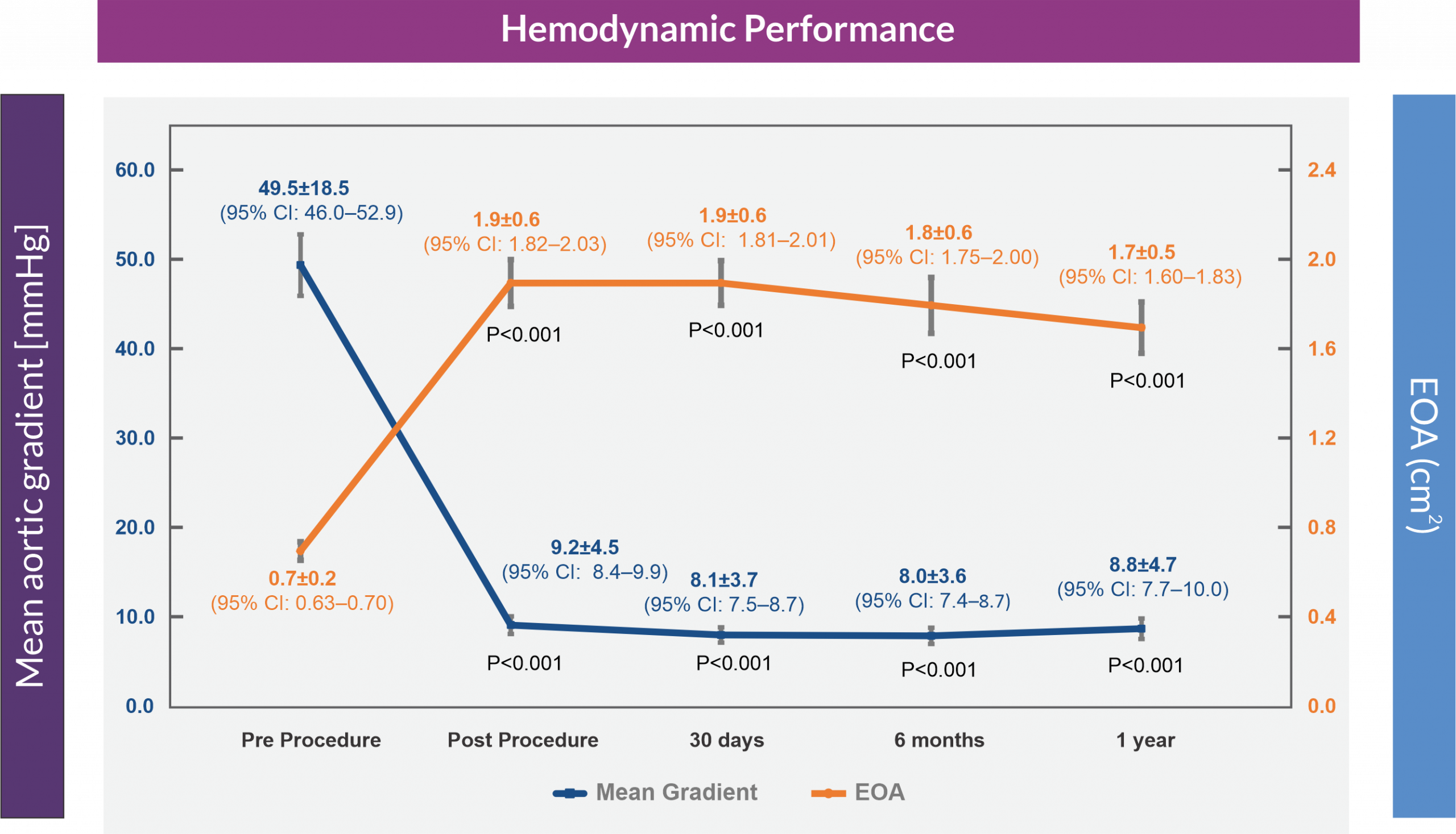
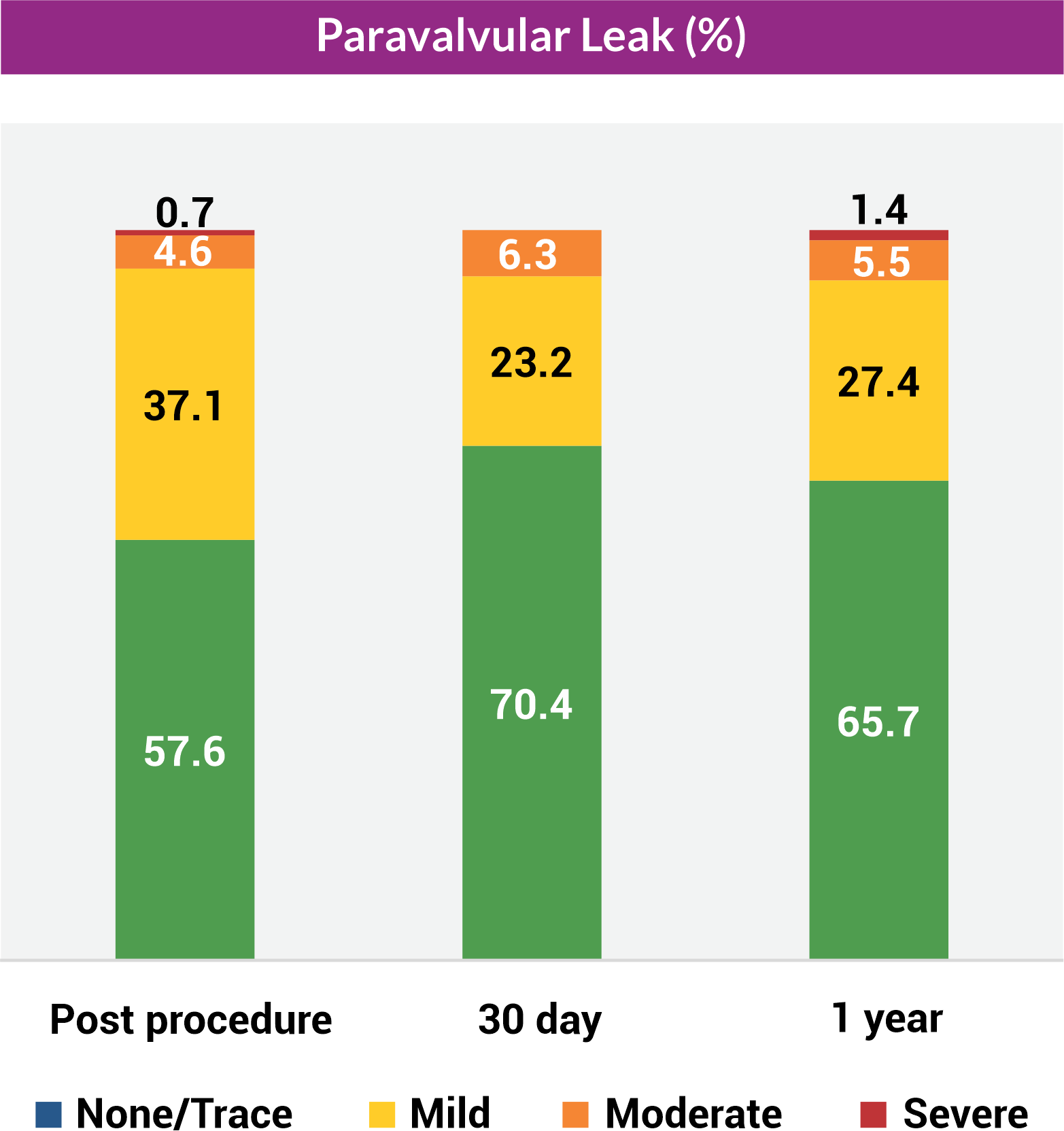
One-year Follow-up Study Results( N=157)
Mean Aortic Valve Gradient and Effective Orifice Area (EOA)
Paravalvular leak
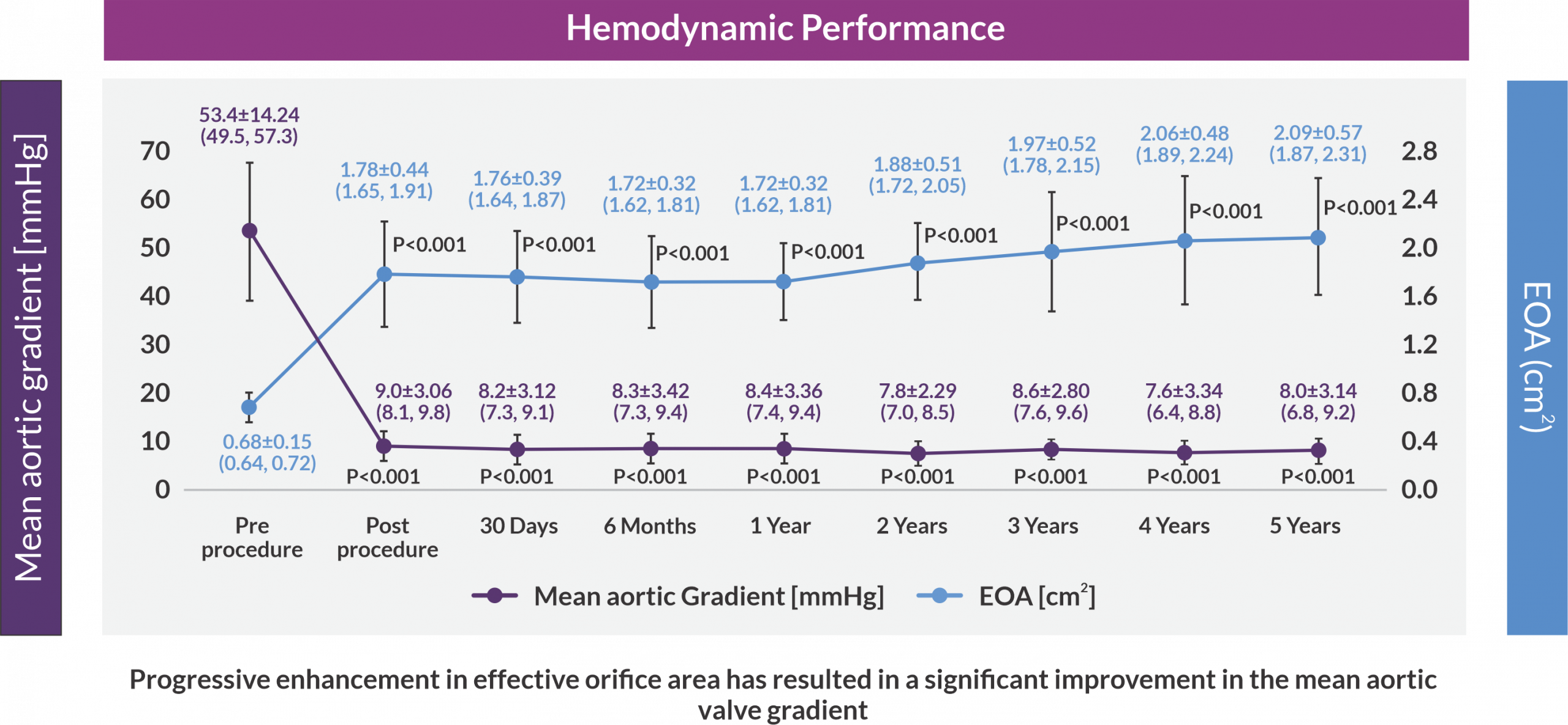
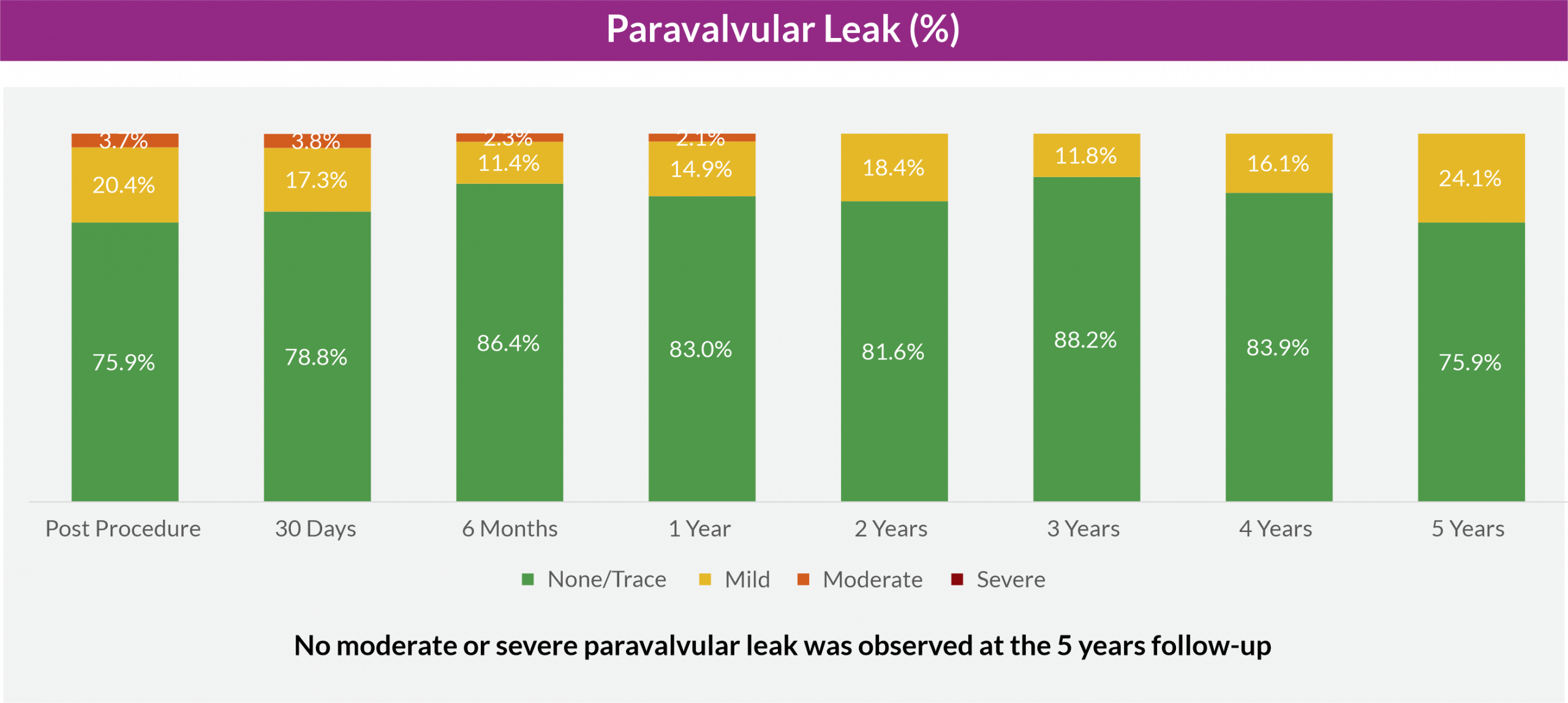
Long-term Follow-up Study Results (N=54)
Mean Aortic Valve Gradient and Effective Orifice Area (EOA)
Paravalvular leak

Conclusion
The results of the Hydra CE study demonstrated favorable and sustained 3-year safety and performace providing large effective orifice area and low transvalvular gradient as well as high survival rates and acceptable complication rates with regards to paravalvular leak, new permanent pacemaker, stroke, major vascular complications, bleeding with the self-expanding Hydra THV in patients with symptomatic severe aortic stenosis and high or extreme surgical risk.
Additional Information
Baseline Characteristics
| Characteristics | One-year Follow-up Cohort (N=157) | Long-term Follow-up Cohort (N=54) |
|---|---|---|
| Age (years) | 79.2±7.1 | 81.0 ± 4.1 |
| Age <75 years | 32 (20.4) | 3 (5.6) |
| Male | 65 (41.4) | 15 (27.8) |
| Body-mass index | 26.0±5.2 | 28.6 ± 5.3 |
| Body surface area, kg/m2 | 1.7±0.2 | 1.8 ± 0.2 |
| Coronary artery disease | 65 (41.4) | 21 (38.9) |
| Previous CABG | 22 (14.0) | 9 (16.7) |
| Previous PCI | 38 (24.2) | 12 (22.2) |
| History of MI ≥6 months | 17 (10.8) | 9 (16.7) |
| History of atrial fibrillation | 30 (19.1) | 18 (33.3) |
| Left bundle branch block | 7 (4.5) | 5 (9.3) |
| Right bundle branch block | 10 (6.4) | 7 (13.0) |
| Permanent pacemaker | 12 (7.6) | 8 (14.8) |
| Heart Failure | 14 (8.9) | 8 (14.8) |
| NYHA Functional Class | ||
| Class-I | 1 (0.6) | 0 |
| Class-II | 77 (49.0) | 16 (29.6) |
| Class-III | 72 (45.9) | 38 (70.4) |
| Class-IV | 7 (4.5) | 0 |
| Diabetes mellitus | 48 (30.6) | 11 (20.4) |
| Hypertension | 125 (79.6) | 51 (94.4) |
| Prior stroke | 13 (8.3) | 3 (5.6) |
| Prior TIA | 0 | 0 |
| Peripheral artery disease | 4 (2.5) | 1 (1.9) |
| Chronic kidney disease | 40 (25.5) | 31 (57.4) |
| COPD | 21 (13.4) | 4 (7.4) |
| Asthma | 8 (5.1) | 1 (1.9) |
| Pulmonary hypertension | 19 (12.1) | 4 (7.4) |
| Moderate/severe AR | 17 (10.8) | 0 |
| Moderate mitral regurgitation | 16 (10.2) | 1 (1.9) |
| Moderate tricuspid regurgitation | 15 (9.6) | 2 (3.7) |
| STS Score (%) | 4.7±3.4 | 3.2 ± 2.0 |
| EuroScore II | 5.1±4.9 | 4.0 ± 3.2 |
| Haemoglobin, g/dL | 11.9±2.0 | 12.7 ± 1.5 |
| Serum creatinine, μmol/L | 1.2±1.1 | 1.1 ± 0.4 |
| Creatinine >2 mg/dL | 10 (6.4) | 3 (5.6) |
| eGFR, mL/min/1.73m2 | 59.0±21.6 | 62.01 ± 15.5 |
| LVEF, % | 56.4±13.2 | 54.6 ± 5.6 |
| Mean aortic gradient, mmHg | 49.5±18.5 | 53.4 ± 14.24 |
| Aortic valve area, cm2 | 0.7±0.2 | 0.68 ± 0.15 |
| Prior stroke | 13 (8.3) | 3 (5.6) |
| Prior TIA | 0 | 0 |
Procedural Characteristics
| Variables | One-year Follow-up Cohort (N=157) | Long-term Follow-up Cohort (N=54) |
|---|---|---|
| Trans-femoral Access | 157 (100) | 54 (100) |
| 18 Fr introducer sheath (Cook Check-Flo) | 157 (100) | 54 (100) |
| Local anaesthesia and conscious sedation | 69 (43.9) | 48 (88.9) |
| Implanted valve size | ||
| Hydra 22 mm | 4 (2.5) | 0 |
| Hydra 26 mm | 72 (45.9) | 19 (35.2) |
| Hydra 30 mm | 81 (51.6) | 35 (64.8) |
| Pre-dilatation | 126 (80.3) | 53 (98.1) |
| Post-dilatation | 81 (51.6) | 27 (50.0) |
| Procedure time, min | 122.8±57.0 | 116.8 ± 36.4 |
| Fluoroscopy time, min | 31.7±18.8 | 27.6 ± 12.0 |
| Contrast Volume, mL | 130.7±72.2 | 140.4 ± 50.3 |
| Duration of hospital stay, days | 7.2±6.3 | 8.8 ± 7.7 |
Device Success
| Variables | N=157 | 95% CI |
|---|---|---|
| Device Success | 130 (82.8%) | 75.8, 88.2 |
| Successful implantation | 148 (94.3%) | 89.0, 97.2 |
| One valve implanted (i.e. no need for second valve) | 148 (94.3%) | 89.0, 97.2 |
| Proper anatomical location | 146 (93.0%) | 87.5, 96.3 |
| Single valve in correct position | 142 (90.3%) | 84.5, 94.4 |
| Aortic valve area >1.2 cm2 | 145 (92.4%) | 86.7, 95.8 |
| Mean aortic valve gradient <20 mmHg | 150 (95.5%) | 90.7, 98.0 |
| Moderate or severe paravalvular leak | 11 (7.0%) | 3.3, 11.7 |
| Prosthesis–patient mismatch | 22 (14.0%) | 9.2, 20.7 |
| Severe prosthesis–patient mismatch | 9 (5.7% | 2.8, 11.0 |
| Procedural mortality | 3 (1.9%) | 0.2, 5.0 |